My name is Jeff and I'm a pastor of a small, local, Christian fellowship

It's a wonderful thing to love your work; to know that when you do it you are doing something that you were born to do. I am so fortunate to be both. I don't say I am the best at what I do. God knows that are so many others who do it better. But I do feel fairly lucky to be called by such a good God to do work I can only do with his help, to be loved by a beautiful woman, and to have a workshop where I can work my craft. These musings of mine are part of that work.
Powered By Blogger

Tuesday, August 9, 2016

Led not lost: A meditation on Exodus 15:22-27 and disappointment


Ayun Musa, the traditional site of this site
Then Moses led Israel from the Red Sea, and they went out into the wilderness of Shur; and they went three days in the wilderness and found no water. When they came to Marah, they could not drink the waters of Marah, for they were bitter; therefore it was named Marah.” Exodus 15:22-23, NASB

Hope deferred makes the heart sick...” Proverbs 13:12, NIV


Philip misses his dad - as we all do
Several years ago, a 54-year-old man in our fellowship who didn't like the way the heart medicine he had been prescribed made him feel, decided to go off his meds and “trust God for his healing.” Within a few months of that decision he had a fatal heart attack and died while driving home one afternoon. While his wife has weathered the storm well enough, his fifteen-year-old son remains in the thick of it angry that he has been robbed of his dad before his time. In his own words pasted on his Facebook wall recently, “Obviously whoever said that it will get better has never lost their father. #goingdownNotup#missdad.”


They are an amazing couple
A young couple from Refuge, who have been trying desperately to have a child for over a year, with joy shared with all of us on a Sunday morning a few weeks ago that at long last they were with child. The woots and the applause were spontaneous as everyone knew they had been trying to conceive for some time. Last week, when they went to the doctor for a check-up, their joy was popped like a soap bubble in the summer air when the ultrasound revealed that their baby had died a few weeks ago.


The future is uncertain - but then, it always is
Back in June, my father-in-law went to see his doctor due to issues he thought had to do with his stomach. But after a series of tests they learned that he had a malignant tumor the size of a fist on his liver. Just the other day when he and my mother-in-law sat down to discuss the action plan with the surgeon they were informed that he had, in fact, Stage 4 cancer, and given that the tumor had already metastasized to his lungs the best plan of action was no plan whatsoever. Whatever news they were expecting to hear this was not it.

All of us who follow Jesus know that these vignettes are not extraordinary or unusual. Things like this – and worse! – happen to followers of Christ all the time. In fact, just as Jesus reminded his first disciples, stories such as these are fulfillment of his promise: “In this world you will have trouble” (John 16:33, NIV). Disappointment and hope waylaid are at times par for the course.

One theory of which way they went


I think of the Children of Israel fresh from their deliverance from Egypt. They had walked through the waters on dry ground and watched the liquid wall collapse like an avalanche upon the pursuing chariots of Pharaoh. The sight of some of the bodies of the men who but a short time ago were in hot pursuit of them now washing up upon the shore like so much flotsam and jetsam was certainly part of the inspiration for the song of victory that arose shortly afterward (Exodus 15:1-21). But now, safe on the the other side of the sea, what do they find there? Nothing. Nada. Zilch.


Author Thomas Cahill describes the Sinai peninsula as “one of our planet's most desolate places. It would be hard to conjure up a landscape more likely to lead to death – a land bereft of all comfort, an earth of so few trees and plants that one may walk for hours without seeing a wisp of green, a place so dry that the uninitiated may die in no time, consumed by what feels like preternatural dehydration. By contrast, the gentler Judean desert of John the Baptist seems almost an oasis” (The Gift of the Jews, pp. 132-33). Bruce Feiler adds that the Sinai has often been “referred to as '24,000 square miles of nothing'” (Walking the Bible, p. 203). When I hear the word, “wilderness”, something out of a John Muir sketch comes to mind, beautiful mountain vistas crossed now and then with sparkling glacier streams. But in the Sinai I should think the moon, desolate and empty.


In such a moonscape like the Sinai water is everything. So three days after the Red Sea crossing, at the limit that a normal human body can tolerate before risking death by dehydration, the sojourning people of God spy an oasis creep up over the horizon. Their spirits must have soared again knowing that soon their thirst could be slaked and their bleating livestock watered. Did some of them race ahead to get first dibs at the watering hole? But no sooner do they arrive than they discover that the water is undrinkable and bitter, like being teased by a mirage but worse because a mirage isn't wet. Their disappointment is palpable and the discontented murmur of thousands must have sounded like a hive of angry bees suddenly overturned.

Moses, the focal point of the people's ire and dissatisfaction, cries out to Yahweh and he provides an unusual solution: “God pointed him to a stick of wood. Moses threw it into the water and the water turned sweet” (Exodus 15:25). There are some commentators who write a lot about certain kinds of trees that have restorative powers when thrown into brackish water but personally it seems to me in their rush to demonstrate that what we are reading inside the pages of Holy Writ is scientifically provable they miss the point: once again, with their backs against the wall, God had provided for them in a miraculous way, just as he had at Pi Hahiroth (Exodus 14:1). Yahweh had asked Moses to take a step of faith – throw a stick of wood into the water – and watch what happens. The moral being that at the crossroads of disappointment and unbelief, trust and faith are always required.

But something else happens at the place that they would later call Marah: they learn something new about the Lord who had delivered them from the hand of Pharaoh:

That’s the place where God set up rules and procedures; that’s where he started testing them. God said, “If you listen, listen obediently to how God tells you to live in his presence, obeying his commandments and keeping all his laws, then I won’t strike you with all the diseases that I inflicted on the Egyptians; I am God your healer.” (Exodus 15:26)


As Karen Lee-Thorp paraphrases the same moment,

Trust me, obey me, and I will take care of your physical needs. Ignore me, and you are at the mercy of the climate, the food supply and of things called “germs” that you know nothing about. Yahweh must have felt like the parent of two million two-year-olds, with only one eighty-year-old nurse to commiserate with (Story of Stories, pp. 51-52).

Hundreds of years before at the top of Moriah Abraham had learned a new truth about Yahweh – that He was the God Who Provides. In the nick of time, He had provided the ram for the sacrifice in response to the Abraham's act of trust. Now at the bitter waters of Marah God reveals that He is the God Who Heals. Just as he healed the waters, he is able to restore those who choose to honor and hold true to him even when their hope has been waylaid. In fact, while obedience won't necessarily give us a free pass from hardship he promises that when it comes it won't be considered judgment. Rather, it will force our true colors to come out, revealing how deep our confession really runs.


There is something else I missed before but those more studied in these matters have since pointed out to me: they were led to Marah. That's where the Cloud, the physical manifestation of the Lord's presence among them, took them. They didn't stumble across the bitter waters of Marah by “accident.” Rather, it was by design to prove what was in them. As J.A. Motyer observes,Every move in whatever direction, every stop and start, every turn of the pathway was by the will of God. Whether they were in the comforts of Elim or in the dire straits of Rephidim, it was because the Lord had led them there.” (The Bible Speaks Today: The Message of Exodus, pp. 177-78).


As Lee-Thorp puts it:

This whole desert journey was the beginning of a school. Yahweh had trained Abraham, Isaac, Jacob and Jacob's sons as individuals; now he had to put more than a million people through the same course. Some of them weren't even Jacob's descendants and had heard of Yahweh only a few months earlier. Nearly all of them had grown up as slaves and children of slaves. This stage in Yahweh's plan was about transformation...


...To change from slaves into servants, the people had to learn fear – and at the same time trust – Yahweh more than any other gods or human. One might expect that the plagues, the Reed Sea miracle and the constant physical presence of the cloud would have convinced them, but dry mouths and growling stomachs proved otherwise. Hence, Yahweh deprived them of the sources of their basic necessities to force them to depend on him. Then each day he provided just what they needed, so as to reinforce an attitude of daily dependence (Story of Stories, pp. 52-53).


So trouble and difficulty is all a part of the journey and the story that God is writing with our lives. Whether the place we're at is Marah where our hopes have gone awry or at the copious springs of Elim (Exodus 15:27) where it is so easy to be at peace with our lot in the world God desires that we trust his goodness and his purpose to lead us through the harsh terrain ahead. I hope that fifteen-year-old boy finds comfort on the other side of his present rage. I marvel at the woman who just lost her baby as she expresses to me her gratitude that she and her husband could be parents. But I am not surprised when my father-in-law shared with all of us this past weekend gathered for his 80th birthday that whether he is healed or not of the cancer presently growing within him, he will “trust the Master.” It's the way he's talked for as long as I have known him, a confession that arises out of a habit of faith.  


Monday, July 25, 2016

Letting sleeping cattle sleep: in praise of a good vacation

I go among trees and sit still.
All my stirring becomes quiet
around me like circles on water
My tasks lie in their places
where I left them, asleep like cattle.”
from Sabbaths by Wendell Berry

"You have six days each week for your ordinary work, but on the seventh day you must stop working, even during the seasons of plowing and harvest.” Exodus 34:21 NLT

Ten days ago my wife and I began our summer vacation. Due to a number of reasons – some financial, some personal – we opted for a “stay-cation” but even so returned to our routine today rested and refreshed feeling as if we had sat still awhile in the shade of a big tree on a breezy summer day.

These are really the "after" pictures
What did we do that made it so relaxing? We determined to hold plans lightly – if at all – and literally made it up one day at a time.


For starters, we never set our alarm clocks. Early risers that we are – her by necessity and me by old habit – that still meant we began our day around seven-ish but we were in no hurry to get up and get going. We would lounge the morning away in our pjs, drinking our coffee, reading or dozing off to sleep again if either of us felt like it. One of the projects we both wanted to get done while away from our work was paint the front room but somehow when you have nothing else to do that kind of work doesn't feel like labor – especially when you're not on a dead-line. So I steadily worked my way around the room a half wall at a time, day after day after day, taping, patching, cutting and then rolling. It was, in a word, relaxing, especially as more and more of the room got painted. While I puttered away at this project, she was busy upstairs reorganizing Charlie's room (and it did need reorganizing).


It was a beautiful night at the Northern Wisconsin State Fair

We ate out a lot – lunch or dinner and sometimes both in the same day. Nothing too fancy – Subway, NDI, even chicken from Gordy's deli one day. We did make a few outings – the Northern Wisconsin State Fair, a place called Oulu and its famed glass gallery, the Barron County Fair and the Chippewa Valley Railroad at Carson Park in Eau Claire. We went to see some movies – Finding Dory, The Secret Life of Pets and Ice Age Collision Course – and did some movie nights at home (thanks, Emma, for introducing me to The Pirates of Penzance). We were fortunate to see The Red Barn Theater's production of big: the musical one night and one sultry evening all we did was sit out on The Pokegama's deck drinking something cool and watching the boats go by for the rousing price of $5 (tip included).


"big: the musical" was a great show


Oulu Glass Gallery


Mouth of the Brule
Davidson windmill on Hwy 13


And we napped – a lot. Or sat out on our front porch enjoying the evening breeze. We enjoyed pizza in Superior with our son, Ed, one night and then sat on the sidelines as he and the guys from his church played ball against another Duluth fellowship. And on the last day, we were fortunate to have a few hours with Emma dining out at The Olive Garden in Eau Claire. With all the gift cards Linda had in her wallet, what would have cost us $73-something and change only cost us $7. That's right: seven bucks.


Norske Nook in Rice Lake


V.I.P. pizza in Superior


Olive Garden in Eau Claire


Over the years, we've had, overall, good vacations. In 2010 we had an epic one in Washington, D.C. - the last truly family trip we've experienced together. And while the kids were young I don't know how many years in a row we camped at Pattison State Park or Amnicon or Madeleine Island. But what I think I enjoyed most about our time off this year was the pacing of it all – no place really to get to, no set time to get there at (except, of course, the time a movie began). It really was Hakuna matata.


Granted, we didn't have little kids to herd or mind. We had Charlie but Charlie pretty much minds himself and usually joins us on our outings. But this year I was reminded that the secret to a well-spent vacation is to experience rest and renewal so that you can return to whatever is your routine refreshed and invigorated and ready to work again. You don't really need a lot of money for that kind of goal. You just need to be creative and live within your means. And as a friend of mine reminded me, when you frame a vacation like that rest can be a form of worship, simply by stepping out of one's rut for awhile and choose, if you have one, to gently swing in your hammock or sit on your porch enjoying the cool of the day.


Tuesday, June 28, 2016

Sometimes God is a Calvinist: A meditation on Exodus 13:17-14:31

 Then the Lord said to Moses, “Tell the Israelites to turn back and encamp near Pi Hahiroth, between Migdol and the sea. They are to encamp by the sea, directly opposite Baal Zephon. Pharaoh will think, ‘The Israelites are wandering around the land in confusion, hemmed in by the desert.’ And I will harden Pharaoh’s heart, and he will pursue them. But I will gain glory for myself through Pharaoh and all his army, and the Egyptians will know that I am the Lord.” So the Israelites did this.”

Exodus 14:1-4, NIV

...

In Exodus 14:2 the Israelites were directed by God to backtrack to a precisely specified place. If ever an act of God must have seemed unloving this was it, for all too soon they found that they had apparently been led into a trap, which rapidly closed upon them (14:9). And it was their God who had put them there! They were helpless, caught in a vice, and when they looked back on that day, they probably said, as we frequently find ourselves saying, 'We didn't know which way to turn.' What can the Lord have been thinking about?” The Bible Speaks Today: The Message of Exodus by J.A. Motyer, p. 181

There are more than a few opinions on which route they really took
I am a person who generally defines myself as a Christian first. I will quickly add a brief disclaimer that I am a pastor serving a congregation in the Pentecostal tradition but that's only to help an inquiring mind know where to place me. But while I rarely go there to clarify the matter, I generally consider myself an Arminian. That is, I put a lot of emphasis on man's right to choose his eternal destiny, heaven or hell. When things go south, as they sometimes do, I'll wrack that up to the toll of living in a fallen world, sinful free will agents acting out as they are wont to do or the influence of the devil and his minions or a combination of all three. It's not that I believe that God takes a “hands off” approach to what goes on “down here.” Rather, it's the logical conclusion of the conviction that if it is God's will that we choose to acknowledge him willingly of our own free will than that choice involves the risk that we won't. And then stuff happens and bad things with it.


But reading Exodus 14 reminds me that try as we do to nail him down like he is some candidate running for political office, God resists neat little boxes, such as Arminian or Calvinist, that will define him. In fact, the way Moses tells it, God is...well...er, God and therefore he does what he wants for his own reasons that usually at the moment make sense only to him.

Take that climatic moment of the exodus from Egypt, for example. The ten plagues have passed and just as God had promised Pharaoh had had a belly full. He was so done with these Israelites that essentially he evicts them from the country. “Get out of my sight! And watch your step. I don’t want to ever see you again. If I lay eyes on you again, you’re dead” (10:28, Msg). These are the last words he speaks to Moses (that may have been spoken about the same time as his words recorded in 12:31). And thus 400 years of captivity come to an end. What a sight and a sound it must have been the morning following the night of the plague on the First Born. While the multitude of Israel departed in orderly fashion they left behind a country grief-stricken to the core, the air torn with “wild wailing and lament” (12:30).


Beginning around 13:17, there is what I would describe a definite deliberateness in how God leads the people. Instead of taking them up the main highway toward Canaan, he leads them toward the vast unknown of the wilderness. But he has good reasons for doing so which Moses shares with us: they don't know a thing about fighting and if they go straight north they will very shortly run into battle ready troops and quickly rethink the entire venture (vv. 17-22).

But Chapter 14 reads as if God is the Great Puppetmaster, pulling strings and yanking Pharaoh's chain for all it's worth. He instructs Moses to lead the people to a specific place - “near Pi Hahiroth, between Migdol and the sea, directly opposite Baal Zephon” (v. 2) – like a chess master setting the board or an angler setting the hook. He deliberately backs the people into a corner so that under any other circumstances they appear ripe for the picking. As with the case in choosing the desert road, Yahweh shares his reasons with Moses: “Pharaoh will think, ‘The Israelites are wandering around the land in confusion, hemmed in by the desert.’ And I will harden Pharaoh’s heart, and he will pursue themBut I will gain glory for myself through Pharaoh and all his army, and the Egyptians will know that I am the Lord” (14:3-5, NIV).

Naturally, things play out as Yahweh has foreseen. After Egypt is emptied of its labor force, Pharaoh awakens from his emotional hang-over and realizes he has made an incalculable error and sends a battalion of chariots after his slaves to round them up and drive them back to Goshen. When the people see the rising cloud of dust and hear the rumble of hundreds of chariots bearing down on them understandably they freak out. “How could this be?” “How could God do this to us?” “Moses, what were you thinking?” “Didn't we tell you to leave well enough alone?” But what seems like hell unleashing upon them is in fact the set-up for an incredible, never-to-be-repeated wonder that will be remembered for the ages: the same wind that brought the locusts (10:13) now splits the sea and drives it apart (14:20-21). Once again, Yahweh confides in Moses that it's all a part of a larger Plan, a Plan to teach Pharaoh a thing or two. After all that was the opening salvo in the plague narrative, Pharaoh's contemptuous reply to Moses' message from God: “Who is the LORD, that I should obey him and let Israel go? I do not know the LORD and I will not let Israel go” (5:2, NIV). By the time he sees one of his entire battalions of one of the most fiercest weapons of the ancient world swallowed whole by the collapsing walls of sea water he has been schooled sufficiently in who Yahweh is and why it's a good thing to listen to what he says.


But God has other reasons in bringing his people to this specific locale. Not only is it to witness his once-and-for-all defeat of Egypt (Stand firm and watch God do his work of salvation for you today. Take a good look at the Egyptians today for you’re never going to see them again v. 13), not only is it answer definitively Pharaoh's query (“And I will gain glory through Pharaoh and all his army, through his chariots and his horsemen. The Egyptians will know that I am the Lord when I gain glory through Pharaoh, his chariots and his horsemen” vv. 17-18) but to underscore to his own people that while he is good he is also to be feared (“And Israel looked at the Egyptian dead, washed up on the shore of the sea, and realized the tremendous power that God brought against the Egyptians. The people were in reverent awe before God and trusted in God and his servant Moses” vv. 30-31).

Says Motyer:
But where the Israelites saw only an unwanted disaster, the Lord had a purpose that would minister to his glory, give them assurance of faith and secure the future from the menaces of the past. For on That day the LORD saved Israel from the hands of the Egyptians, and Israel saw the Egyptians lying dead on the shore (14:30). At
this demonstration of the great power of the LORD...the people feared the LORD and put their trust in him (14:31) and in his promise that The Egyptians you see today you will never see again (14:13). So there was a purpose after all. God was working his purpose out, bringing his people a benefit which they did not know they needed and dealing with a danger which they thought was past but he knew was not.

Let us learn the lesson: it is the will of God that gives purpose to life. There is always the 'bigger picture' of which he is aware and we are not. There are dangers and menaces, unknown to us, from which he is guarding us, and, above all, there is his conflict with Satan, within which, in ways we cannot possibly know or understand, the joys, sorrows, battles and testings that come upon us are playing their part. Had Israel not been caught – baffled, terrified and helpless – at the Red Sea, there would have been no final defeat of the power that had enslaved them. (The Message of
Exodus, p. 181)

I rarely know what God is up to in my life – why certain prayers don't seem to get answered, why certain things I try don't seem to work, why people I love and care for continue down a path of trouble despite my counsel or earnest prayers to the contrary. He is God and I am not and while I can understand people making bad choices (myself included), I don't comprehend why he wouldn't want to rescue them especially when they begin to suspect they have done wrong. Re-reading Exodus 13-14, however, reminds me that God remains the Red Sea-splitting God he has always been but he always has a Plan, most of which involves provoking me to holy fear and abiding trust in Him regardless of the circumstances of the road I travel.


And all the people said "Amen"

...I believe in the Holy Spirit,
      the holy Christian church,
      the communion of saints,...”
The Apostles' Creed as found in the "Red Book" (Evangelical Lutheran Worship)

This past Sunday Refuge “shut-down” at our locale at the corner of 8th & Leonard and traveled two miles out of town to gather at Luther Park Bible Camp to worship with Chetek/Dovre Lutheran Churches (ELCA). Luther Park was the site of this year's edition of Chetek's Multi-Church Vacation Bible School and since this two-point parish had already planned a combined service out there we decided to “crash” the party (of course, we let them know we were coming.)


For several years now, Refuge has made a habit of doing just this sort of thing. In fact, to date we have preempted our own weekly gathering on Sunday morning and joined the folks at Prairie Lake Evangelical Covenant (ECC), Northside Christian Fellowship (CMA), Advent Christian (ACGC) and Chetek United Methodist (UMC) one or more times for various celebratory reasons. And now for the very first time we've joined the Lutherans (at least, the ELCA ones) in our community.


Love this man
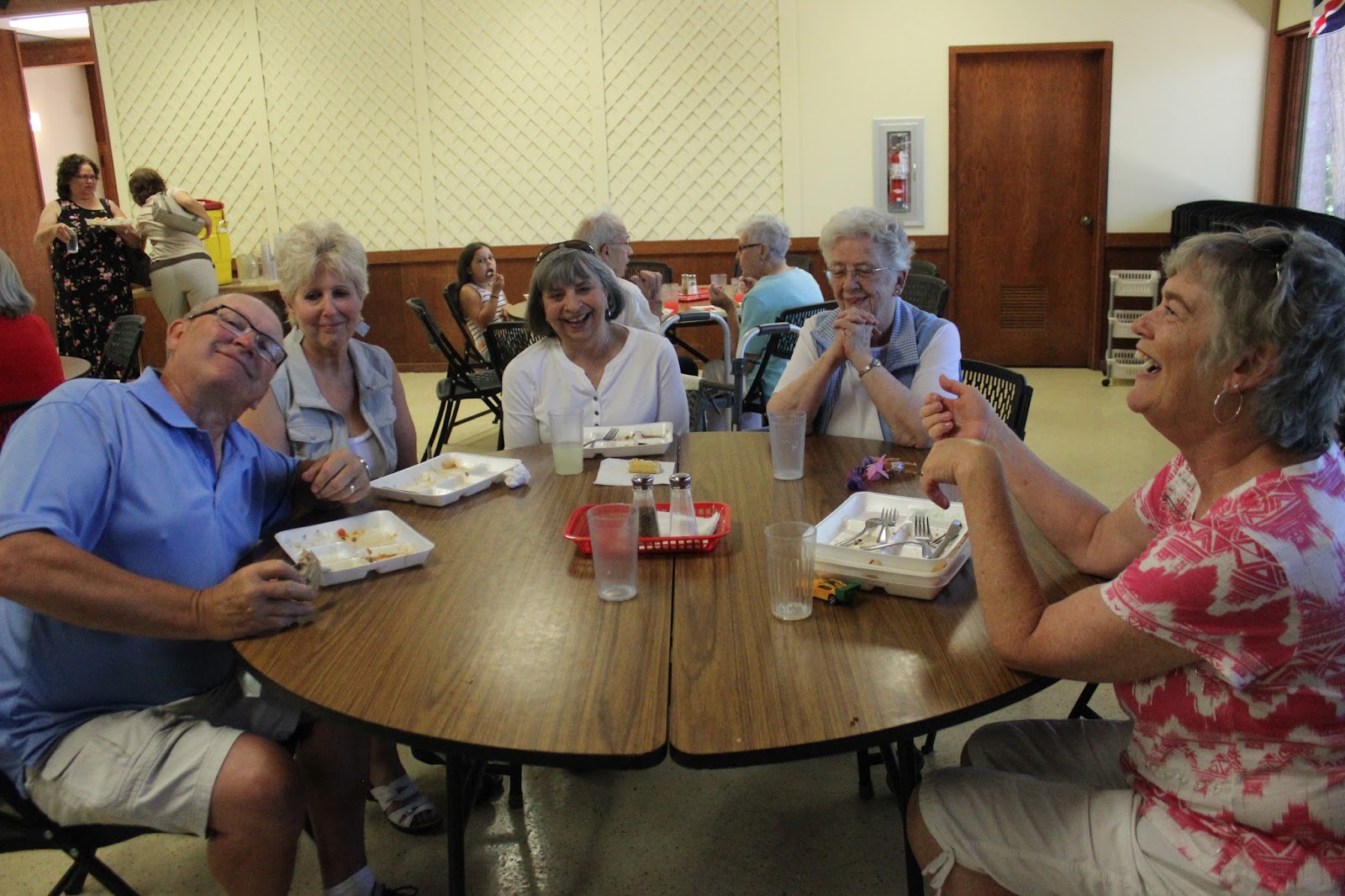
Sunday's gathering was memorable in that it was held in the “sanctuary of the pines” on a beautiful summer morning in northwest Chetek. There was worship, a baptism, there was a selection of songs from VBS, a children's message delivered by myself and then Pastor Guy shared the Word and led in the prayer for the saints. For people like ourselves who generally go until “it's over” I was personally wowed by the fact that as scheduled the service concluded at the 11-bell. Following the gathering, we strolled on over to the dining hall for a pot-blessing meal together. It really was a wonderful gathering from opening song to the last lick of the ice cream cones served in the dining hall after lunch.

Territorial as humans tend to be, whenever we do this sort of thing we never get full participation from our membership. Some people just can't abide stepping out of their comfort zone and entering another fellowship's worship area. As every pastor knows, it's hard enough to try and challenge people to sit in another row in their own sanctuary let alone entering the domain of another. But, we probably had two-thirds present which, I think, is pretty good as those things go.


Refuge belongs to a non-denominational network of Christian fellowships in the Pentecostal tradition (the Fellowship of Christian Assemblies or FOCA) that while sharing a common statement of faith leaves all the other particulars to the local fellowship. We encourage expression in our worship gatherings (although as a group we're a pretty laid back bunch). The Lutherans are maybe slightly more reserved than we are. We welcome a bit of spontaneity. The Lutherans pretty much stick to the script. As a rule we don't baptize infants. We dedicate them. And while save for the basin of water the two acts look very similar, they have very different meanings to their constituents. More broadly, the ELCA took a stand in August 2009 recognizing same-sex marriages as well as choosing to ordain ministers of homosexual orientation. By comparison, the FOCA has no such document. That being said while not a betting man, I would put money on it that you would be hard-pressed to find any of the 300 participating congregations of the FOCA who would support the ELCA's position on these matters. In fact, I know that some of us would be dead-set against them at least in principle. Under what terms can groups as different as ours come together in a meaningful way?


For me, it comes down to our mutual confession of the Apostles Creed which we recited together under the tall pines above Prairie Lake on Sunday morning.

I believe in God, the Father Almighty,
Maker of heaven and earth.
And in Jesus Christ, His only Son, our Lord,
who was conceived by the Holy Spirit,
born of the virgin Mary,
suffered under Pontius Pilate,
was crucified, died and was buried.
He descended into hell.
On the third day He rose again from the dead.
He ascended into heaven
and sits at the right hand of God the Father Almighty.
From thence He will come to judge the living and the dead.
I believe in the Holy Spirit,
the holy Christian Church,
the communion of saints,
the forgiveness of sins,
the resurrection of the body,
and the life everlasting. Amen


Admittedly, we disagree on a lot of things none of which I will say are minor or trivial to either group (i.e., us or them). But we do confess our mutual love and devotion to the Lord Jesus, his suffering, death and resurrection and for four days in late June 2016 we – along with our local Methodist, Advent Christian and Alliance brothers and sisters – pooled our resources and joined hands to share the gospel with nearly 90 kids from our community. It's an act that I think God is pleased with and all his people, regardless of their differing opinions and convictions, can say amen to.